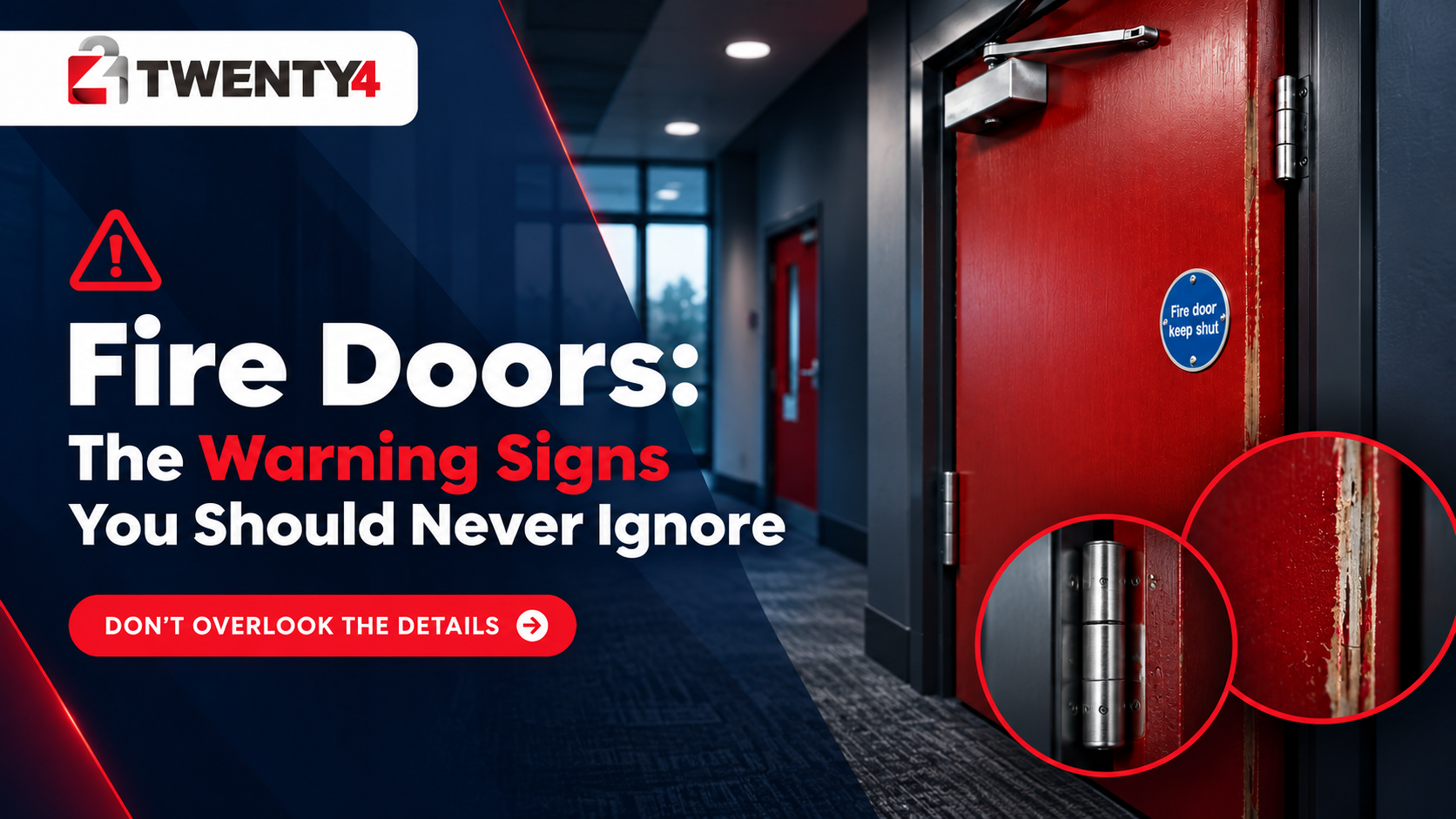
Fire doors can be easy to overlook during the everyday running of a building. They may look like ordinary doors, but in the event of a fire, they have a vital job to do.
Designed to help restrict the spread of fire and smoke, fire doors can provide valuable time for occupants to escape and help protect other areas of a building.
However, a fire door can only provide the intended protection when it is correctly installed and maintained.
For businesses, landlords, schools and property managers, recognising the signs of a damaged or ineffective fire door should form an important part of ongoing fire safety.
1. The Door Doesn’t Close Properly
A fire door should be able to close fully into its frame.
If it sticks, catches on the floor, remains partially open or doesn’t close correctly when released, it requires attention.
Problems with hinges, alignment or the self-closing mechanism can all affect how the door operates.
A fire door that cannot close properly may not be able to perform its intended function during a fire.
2. There Are Large or Uneven Gaps
The gaps around a fire door are important.
If there are noticeably large or inconsistent gaps between the door and frame, the door should be professionally assessed.
Never assume that because a door physically closes, it is automatically providing the required level of fire protection.
3. Intumescent or Smoke Seals Are Damaged
Depending on the fire door specification, seals may be fitted around the door or frame.
Intumescent seals are designed to expand when exposed to heat, helping to restrict the passage of fire. Smoke seals can help limit the movement of smoke.
Missing, painted-over, damaged or incorrectly fitted seals should not simply be ignored.
4. The Door or Frame Is Damaged
Everyday use can take its toll on fire doors, particularly in busy commercial buildings, schools, apartment blocks and other high-traffic environments.
Look for visible damage such as cracks, holes, warping or damage around hinges, locks and other hardware.
Damage to the frame should also be taken seriously.
Even seemingly minor alterations can potentially affect the performance of the complete fire door assembly.
5. Hinges and Hardware Are Loose or Damaged
A fire door is a complete system, rather than simply a heavy door.
Hinges, closers, handles, locks and other components all need to operate correctly.
Loose screws, damaged hinges or faulty closing mechanisms should be addressed promptly rather than waiting until the door stops functioning altogether.
6. The Fire Door Is Being Wedged Open
This is one of the simplest problems to identify – and one that can significantly undermine the purpose of a fire door.
A fire door should not be routinely propped or wedged open.
In busy workplaces it can be tempting to keep doors open for convenience, but doing so can prevent them from restricting fire and smoke if an incident occurs.
Where there is a genuine operational need for a fire door to remain open, appropriate compliant solutions should be considered rather than using a doorstop or wedge.
7. The Door Has Been Altered
Has new hardware been added? Has glazing been changed? Have holes been drilled into the door? Has it been modified during refurbishment work?
Alterations to fire doors need to be treated carefully.
Fire doors are designed and tested as systems, and inappropriate modifications can compromise their performance.
If you’re unsure about previous alterations, arrange for the door to be professionally inspected.
8. Nobody Knows When It Was Last Checked
Fire doors shouldn’t simply be installed and forgotten about.
Buildings change, components wear and doors can be damaged through everyday use.
Regular inspection and maintenance can identify problems before they develop into more significant fire safety concerns.
For property managers responsible for multiple doors, keeping appropriate records of inspections, maintenance and repairs can also help maintain a clear picture of their condition.
Fire Doors in Different Types of Properties
Fire door requirements and risks can vary considerably depending on the type and use of a building.
Commercial premises, schools, healthcare environments, residential developments, HMOs and other multi-occupancy properties can all present different challenges.
High-traffic environments may experience greater wear and tear, while residential and multi-occupancy buildings require particular attention to ensuring fire doors remain effective despite frequent everyday use.
This is why fire door inspection and maintenance should be considered in the context of the individual property rather than treated as a one-size-fits-all exercise.
Don’t Wait Until a Fire Door Fails
Fire doors are a passive form of fire protection. Most of the time, they sit quietly in the background.
But when they are needed, their role can be critical.
A door that doesn’t close, damaged seals or faulty hardware may seem like relatively small maintenance issues. In a fire, however, those details can matter enormously.
Businesses and property managers should therefore make fire door checks part of their wider approach to fire safety.
Professional Fire Door Maintenance from Twenty4 Fire & Security
Twenty4 Fire & Security provides professional fire door maintenance and repair services, helping businesses, landlords and property managers keep their fire doors in appropriate working condition.
Our team can identify issues with existing fire doors and carry out necessary maintenance and repairs as part of a wider approach to protecting your property.
Alongside fire doors, Twenty4 provides a range of fire protection solutions, including fire detection and alarm systems, helping customers manage multiple aspects of their building’s fire safety.
If you’ve spotted damage to a fire door – or simply can’t remember when your doors were last professionally checked – contact Twenty4 Fire & Security to arrange an assessment.